
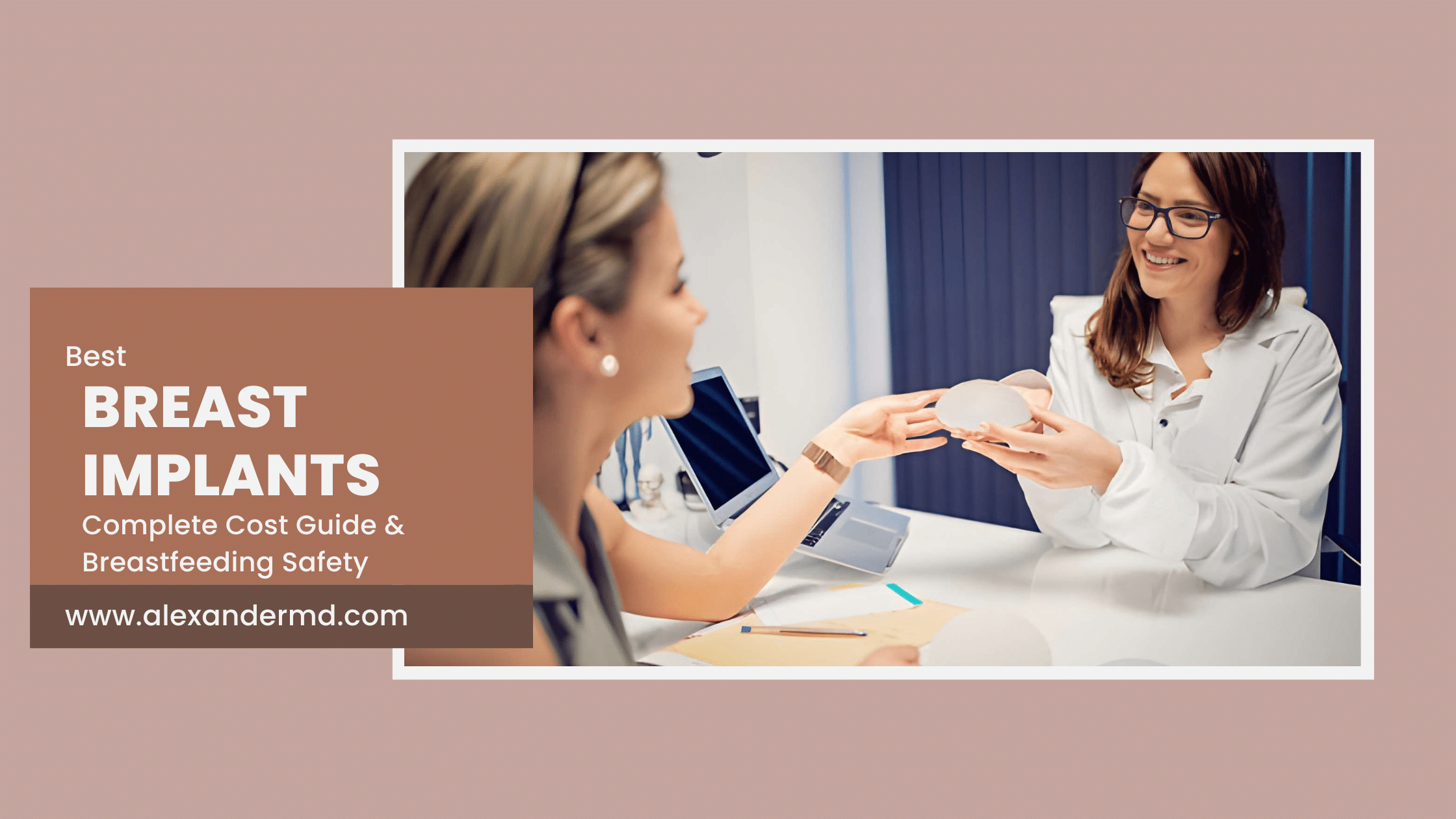
One of the most crucial choices you’ll make during your breast augmentation procedure is selecting the best breast implants. Understanding your options, expenses, and safety concerns is crucial to getting the results you want from the more than 300,000 breast augmentation procedures that are performed in the US each year.
This comprehensive guide from Alexander MD covers everything you need to know about breast implants, from comparing different types to understanding how much breast implants cost and whether you can breastfeed with breast implants safely.
Understanding Breast Implants: Types and Options
Silicone Breast Implants
The most common option for ladies searching for results that look natural is still silicone breast implants. Cohesive silicone gel that closely resembles the sensation of genuine breast tissue fills these implants.
Key Features:
- Soft texture and a natural appearance
- Very little rippling in contrast to saline
- FDA-approved for females 22 years of age and older
- needs routine MRI screening to keep an eye on integrity
Ideal For: Women who value a natural appearance and feel with less noticeable rippling.
Saline Breast Implants
A more affordable option for breast augmentation is saline implants, which are filled with sterile saltwater solution. Your body safely absorbs the solution if a saline implant bursts.
Key Features:
- Placement requires a smaller incision.
- FDA-approved for females 18 years of age and up
- Cheaper (about $1,000–$1,500 less than silicone)
- Simple rupture detection
Best For: Patients on a tight budget who desire a safe, efficient solution with fewer incisions.
Gummy Bear Implants (Form-Stable)
Gummy bear breast implants, also known as form-stable implants, have a thicker cohesive silicone gel that keeps its shape even if the shell splits. For long-term durability, these are among the greatest breast implants.
Key Features:
- Better shape retention
- For natural breast curves, use a teardrop shape.
- Decreased chance of rupture
- needs a bigger incision.
Ideal For: Women looking for optimal long-term stability and a defined contour.
Round vs. Teardrop Implants
Your final appearance is greatly influenced by the contour of your breast implants. While teardrop implants create a natural slope with greater projection at the bottom, round implants offer a fuller upper breast volume with no rotating issues.
Smooth vs. Textured Surfaces
Smooth breast implants slide organically in the breast pocket and feel softer. By creating scar tissue to hold them in place, textured implants lower the chance of rotation. However, many surgeons now choose smooth implants because textured implants have been linked to BIA-ALCL, a rare type of cancer.
Implant Placement: Under or Over Muscle
Submuscular Placement (Under Muscle):
- A more organic look
- Diminished visibility of ripples
- Improved images from mammograms
- A little more time to recover
Subglandular Placement (Over Muscle):
- Reduced recuperation time
- Reduced complexity of surgery
- Thin patients have more noticeable rippling
The optimal placement will be suggested by your surgeon based on your breast tissue, body shape, and desired appearance.
How Much Do Breast Implants Cost? Complete Price Breakdown
National Average Cost in 2026
Knowing how much breast implants cost will help you plan your procedure’s budget. The average cost of a breast augmentation is $4,875, according to the American Society of Plastic Surgeons. But this amount only accounts for a portion of your whole investment.
Breast implants usually cost between $6,000 and $12,000 in total, with prices as high as $15,000 to $20,000 or more in upscale cities like Los Angeles and New York City.
What’s Included in Breast Augmentation Cost?
Take into account these crucial factors while estimating the cost of breast implants:
- The average professional fee for a surgeon is $4,875.
- Fees for anesthesia: $1,000–$1,500
- Fees for the operating room and facilities: $800–$1,200
- Breast implants: $1,000 to $2,500 each
- Prescription drugs and medical examinations
- Clothes worn after surgery
- Follow-up consultations
Cost by Implant Type
Your overall investment is directly impacted by the kind of breast implants you select:
- Each pair of saline implants costs $1,000.
- $2,000 for each pair of silicone implants (usually $1,000–$1,500 more than saline).
- Pairs of gummy bear implants cost more than $2,000.
Geographic Cost Variations
The cost of breast implants varies greatly depending on where you live. Current data reveals:
- $6,500 to $12,000 in California
- $7,000 to $15,000 in New York
- $5,500–$10,000 in Texas
- Tennessee: $7,100 for silicone, $6,200 for saline
- Alabama: $6,000 (the lowest US average)
While smaller marketplaces provide more affordable options without necessarily losing quality, urban areas with higher living expenses deserve premium pricing.
Factors Affecting Your Final Cost
The cost of breast implants varies depending on a number of factors, including:
- Experience and qualifications of the surgeon: Experienced, board-certified plastic surgeons usually charge more but produce better outcomes.
- Implant size and type: Silicone and gummy bear implants are more expensive than saline ones.
- Surgical complexity: Costs are increased when augmentation and a lift are combined.
- Type of facility: Surgery performed in a hospital is more expensive than at an outpatient facility.
- Type of anesthesia: Local anesthesia is less expensive than general anesthesia.
Financing Options for Breast Augmentation
Many procedures provide financing options because insurance rarely covers cosmetic breast augmentation:
- CareCredit: 6–24 months of interest-free medical financing
- Plans for internal payments
- Individual loans
- Accounts for health savings (HSA)
Always ask for all-inclusive estimates when comparing prices to prevent unstated expenses. While advertising affordable pricing, some practices charge more for higher implant sizes, clothing, and facility fees.
Can You Breastfeed With Breast Implants? Complete Safety Guide
The Short Answer: Yes, Most Women Can Breastfeed
The ability to breastfeed while wearing breast implants is one of the most prevalent worries among women. Fortunately, the majority of women who have breast implants are able to effectively nurse their infants. Breastfeeding with breast implants is generally safe for both mother and child, according to Johns Hopkins Medicine, the CDC, and the American Academy of Pediatrics.
How Breast Implants Are Placed
You can nurse with breast implants if you understand breast anatomy. Instead of being placed inside the breast tissue and milk glands, implants are placed behind them. Because of their positioning, the mammary glands and milk ducts can continue to produce milk.
Factors That Affect Breastfeeding Success
Incision Location Matters Most
Your ability to breastfeed with breast implants is greatly impacted by the location of your incision:
Inframammary (Under Breast): Lowest impact on breastfeeding as it avoids milk ducts and nerves entirely.
Transaxillary (Armpit): Very little disruption of breast ducts and tissue.
Periareolar (around the nipple): Increased risk of nerve or duct injury that may impact sensation and milk production.
Implant Placement Impact
Because implants are positioned behind the chest muscle and away from breast tissue, submuscular implantation (under muscle) typically has less of an effect on milk production.
The majority of women are still able to successfully breastfeed despite the somewhat increased pressure on the mammary glands caused by subglandular positioning (over muscle).
Is It Safe for Baby?
Many moms are concerned about the potential harm that silicone from breast implants may cause to their infants when they are nursing. Research constantly demonstrates that there is no harm to newborns when breastfeeding with breast implants. Research shows that silicon levels in breast milk are lower than those in cow’s milk and baby formula, regardless of whether implants are present or not.
Potential Breastfeeding Challenges
Although the majority of women with breast implants are able to breastfeed, some may encounter:
- decreased milk production (but not total incapacity to breastfeed)
- Damage to nerves or ducts in sensitive areas after surgery
- Inability to establish supply because of diminished feeling
- discomfort brought on by implant pressure or scar tissue
How to Maximize Breastfeeding Success
Take the following actions if you intend to breastfeed following breast implants:
- To determine the ideal site for the incision, discuss your plans with your surgeon prior to the treatment.
- To ensure a sufficient supply, breastfeed regularly (eight to ten times a day).
- Consult a lactation consultant with knowledge of enlarged breasts.
- To guarantee proper nutrition, keep an eye on the baby’s weight gain.
- Use formula or donor milk as a supplement if necessary.
- To increase milk transfer, use the right latching techniques.
Timing: Implants Before or After Pregnancy?
Consider delaying getting breast implants until after you’ve stopped nursing if you intend to become pregnant in the near future. Breast size and form naturally fluctuate during pregnancy and lactation, which may have an impact on the outcome of your implant. It is usually advised by surgeons to postpone breast augmentation for six to twelve months following the conclusion of breastfeeding.
However, you can usually still effectively nurse if you already have implants and become pregnant.
Choosing the Right Surgeon
Selecting the best breast implants starts with choosing the right surgeon. At Alexander MD, we prioritize patient safety and natural-looking results. Look for these qualifications when selecting your surgeon:
- American Society of Plastic Surgeons (ASPS) board certification
- extensive background, particularly in breast augmentation
- Hospital privileges for the treatment
- Gallery of before and after photos demonstrating steady, organic outcomes
- Clear pricing with no additional costs
Questions to Ask During Consultation
What is the number of breast augmentation treatments you undertake each year?
- What are the rates of complications and revisions?
- Which implant types are best for my goals and body type?
- What impact will my decision have on my ability to breastfeed?
- What does the price you quoted include?
- What is your policy for revisions?
Red Flags to Avoid
- Prices that are far lower than the market average
- “Limited time” or pressure strategies provide
- Surgeons who do not specialize in plastic surgery
- Unfavorable internet reviews or patient grievances
- unwillingness to talk about dangers and difficulties
Final Considerations
Your particular anatomy, aesthetic objectives, financial constraints, and lifestyle choices will determine which breast implants are best for you. There is an implant option that suits your needs, regardless of your priorities—natural feel, affordability, or nursing potential.
Keep in mind that breast implants are not permanent. Before needing to be replaced, most implants survive ten to twenty years. When determining the lifetime cost of breast implants, consider any future expenses.
Above all, pick a board-certified plastic surgeon who pays attention to your worries, fully responds to your inquiries, and develops a customized surgical plan that fits your objectives.
Ready to Take the Next Step?
Make an appointment with a board-certified plastic surgeon to go over your options, see before and after pictures, and get a customized pricing estimate. Selecting the ideal breast implants for your particular requirements is the first step on the path to more self-assurance and contentment.
Interested in other cosmetic procedures? For more information about face and body procedures, including facelifts, liposuction, tummy tucks, and rhinoplasty, visit Alexander MD’s complete treatments.
Frequently Asked Questions
What is the lifespan of breast implants? A: Although they are not regarded as lifetime devices, breast implants usually last 10 to 20 years. Eventual replacement and routine monitoring are anticipated.
Can cancer be brought on by breast implants? A: Breast cancer is not a direct result of breast implants. However, a rare type of lymphoma called BIA-ALCL has been connected to textured implants. There is little risk associated with smooth implants.
Will breast implants be covered by insurance? A: Insurance rarely covers cosmetic breast augmentation. The Women’s Health and Cancer Rights Act may provide reimbursement for reconstructive operations following a mastectomy.
What is the total cost of breast implants? A: Depending on the implant type selected, surgeon experience, and geographic area, total prices can vary from $6,000 to $12,000.
Is it possible to effectively nurse while wearing breast implants? A: The majority of women who get breast implants are able to effectively breastfeed. Breastfeeding ability is mostly dependent on the location of the incision and the surgical method.