
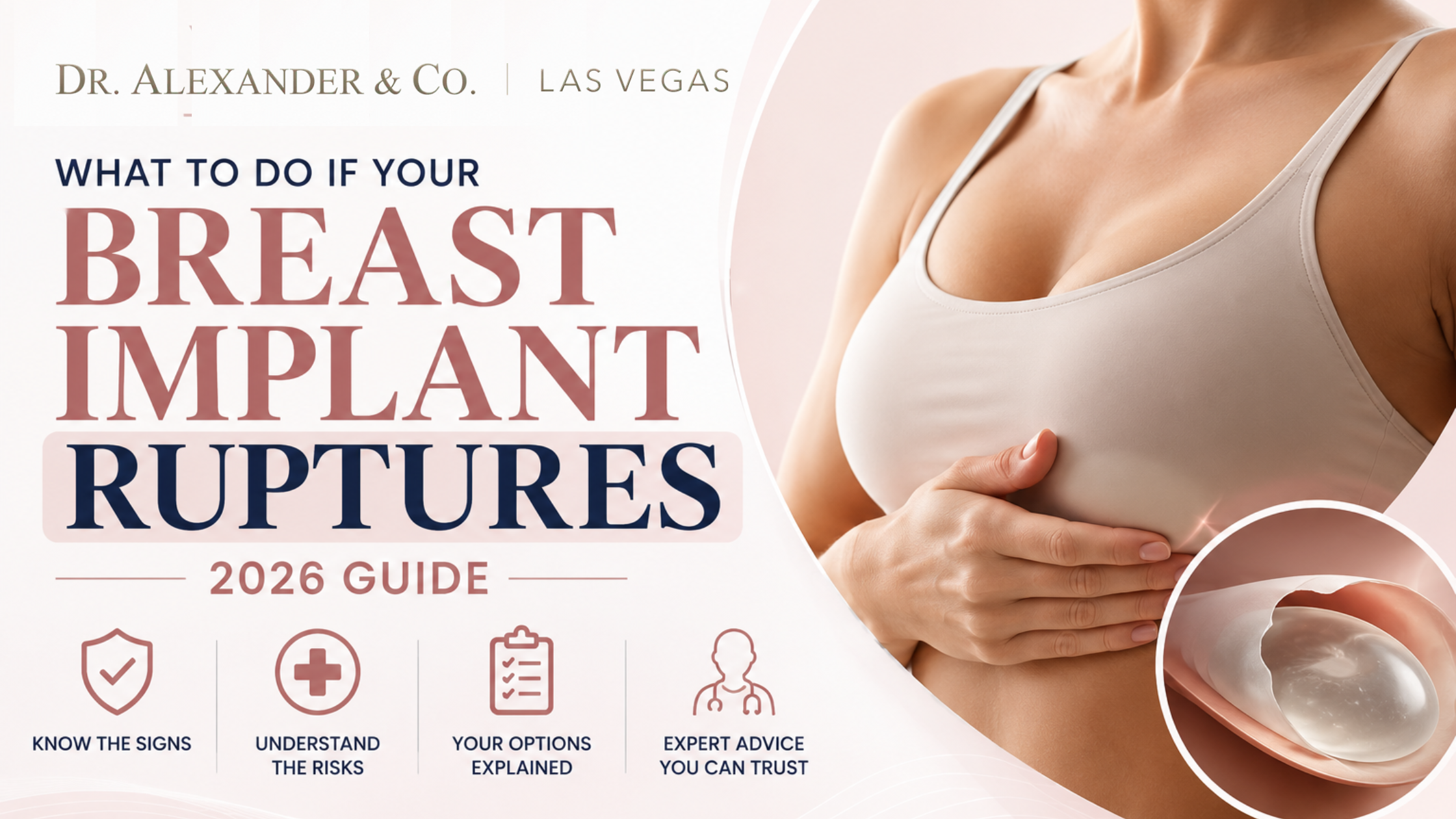
Breast implants are not lifetime devices. Over time the outer shell can weaken and tear. Some people notice it right away. Many people notice nothing at all.
If you think your implant has ruptured, you probably want clear answers fast. This guide gives them.
Quick Answers (Read This First)
- A rupture is not usually an emergency. But do not ignore it. Book an appointment with your plastic surgeon soon.
- A torn shell does not heal. The implant has to be removed or replaced with surgery.
- Saline implants: the breast shrinks, often within days. The salt water is absorbed by your body and is safe.
- Silicone implants: you may feel nothing. This is called a silent rupture. Only an ultrasound or MRI can find it.
- Screening for silicone implants (FDA advice): first ultrasound or MRI at 5 to 6 years after surgery, then every 2 to 3 years.
- Your options after a rupture: replace the implant, remove it, or remove it and add a breast lift.
Worried right now? Book a consultation with our team so we can check your implants and explain your options.
How Common Is a Breast Implant Rupture?
Breast Implant Rupture can happen at any time, but the chance goes up as the implant gets older. The FDA says clearly that implants are not lifetime devices, and the longer you have them, the more likely you are to need another surgery.
There is no single number that fits everyone. Your risk depends on:
- The brand and model of your implant
- How long you have had it
- Whether you have scar tissue problems (capsular contracture)
- Whether you have had any injury or procedure near the implant
Some older implants fail earlier than newer ones. If you do not know your implant brand, age or type, ask your surgeon for your implant card or surgery records.
What Causes a Breast Implant to Rupture?
Sometimes there is a clear cause. Often the shell just wears out over time.
- Age: the shell slowly weakens. This is the most common reason.
- Injury: a hard hit to the chest, such as a car accident, can damage an implant.
- Capsular contracture: scar tissue around the implant tightens and puts stress on the shell.
- Mammogram pressure: damage is uncommon, but it has been reported.
- Needle or instrument damage: biopsies, fluid draining or surgery near the implant can sometimes nick the shell.
- Wrong filling (saline implants): too much or too little saline can raise the risk.
Most of the time, the rupture is not your fault. You did not cause it by normal daily life.
Signs of a Breast Implant Rupture
The signs depend on your implant type. The table below shows the main differences.
| Saline implant | Silicone implant | |
|---|---|---|
| How obvious is it? | Usually very obvious | Often silent, no signs |
| What happens | Salt water leaks out and the breast shrinks | Gel usually stays inside the scar tissue around the implant |
| Common signs | One breast smaller, change in shape, loss of fullness | Pain, hard breast, shape change, lumps (if any signs appear) |
| How it is found | Exam, and often it is easy to see | Ultrasound or MRI |
| Is the leak harmful? | No, the body absorbs saline | Needs a surgeon’s review, because gel can spread |
Signs to watch for
- One breast looks smaller or different from the other
- A change in the shape of the breast
- New pain or tenderness
- A breast that feels harder than before
- A new lump in the breast or armpit
- Swelling, tingling or a change in feeling
These signs can also come from other problems, such as infection or scar tissue. Do not guess. Get it checked.
What is a silent rupture?
A silent rupture is a torn silicone implant with no signs. The breast looks and feels normal. This is why the FDA recommends scans for silicone implants even when you feel fine.
Two Types of Silicone Rupture
- Intracapsular (inside the scar tissue): the shell is torn, but the gel stays inside the scar capsule your body built around the implant. This is the most common type and is easy to miss.
- Extracapsular (outside the scar tissue): the gel has moved past the capsule into nearby breast tissue, and sometimes into lymph nodes in the armpit. This is harder to treat because the surgeon must find and remove gel outside the implant pocket.
Your surgeon needs to know which type you have to plan the right surgery.
Is a Ruptured Implant Dangerous?
Saline: The leaked salt water is absorbed and is not harmful. The empty shell still needs to be removed.
Silicone: The gel is not known to cause sudden, serious illness. The concern is what it can do over time:
- Spread into breast tissue or lymph nodes
- Cause pain, swelling or inflammation
- Make a later surgery harder
A contained rupture can stay quiet for a long time. But “quiet” does not mean “safe to ignore”. A surgeon should look at it and tell you whether to watch it or operate.
How Do Doctors Check for a Rupture?
- Physical exam. The surgeon checks size, shape, firmness, swelling and pain. This can spot a deflated saline implant. It cannot rule out a silent silicone rupture.
- Ultrasound. A simple, painless scan. It is an FDA-accepted option for silicone implant screening. It is often the first test.
- MRI (without contrast). The most detailed scan for silicone implants. It can show if the shell is torn and whether gel has escaped the capsule. It is often used when the ultrasound result is unclear.
Screening schedule for silicone implants (FDA advice)
- First scan: 5 to 6 years after surgery
- After that: every 2 to 3 years
- Saline implants: no routine scans needed, because deflation is usually easy to see
Tip: If you are more than 6 years out from surgery and have never had a scan, book one now. Do not wait for symptoms.
What to Do If You Think Your Implant Has Ruptured
- Call your plastic surgeon. Do it soon, ideally within a few days. Sudden shrinking, new pain or a shape change are reasons to call.
- Get the right scan. Your surgeon will choose an exam, ultrasound or MRI.
- Ask what type of rupture it is. Ask if it is inside or outside the capsule, and if any gel has spread.
- Talk through your options. Replace, remove, or remove with a lift (see below).
- Be careful until you are checked. Do not massage, squeeze or try to treat the implant yourself. Avoid hard chest workouts and heavy lifting until your surgeon says it is fine.
Go to urgent care or the ER if you have: a fever or chills, spreading redness or heat, very fast swelling, or severe pain.
How long can I wait for surgery?
- Saline: the implant is already deflated, so it is not urgent. But do not leave it for years. The shell still needs to come out, and the breast shape can change.
- Silicone: a rupture is not an emergency, but do not leave it for a long time. Waiting makes it harder to know if gel has spread. Plan your evaluation soon and follow your surgeon’s timeline.
Your surgeon can give you a specific timeline after looking at your scan.
Your Treatment Options
Option 1: Implant exchange (replace the implant)
The surgeon removes the damaged implant and puts in a new one in the same surgery.
- Good for: people who like their look and want to keep their size
- Also possible: choose a smaller or larger size, if your body allows it
- Extra work that may be needed: if there is capsular contracture or leaked gel, the surgeon may remove some or all of the scar capsule (this is called a capsulectomy). This is not needed in every case.
Option 2: Implant removal only
The surgeon removes the implant and does not replace it.
- Good for: people who no longer want implants
- What to expect: your breasts will look different from before surgery. The result depends on your natural breast tissue, skin stretch, implant size and how long you had implants.
Option 3: Implant removal with a breast lift
A breast lift (mastopexy) removes extra skin and lifts the breast and nipple.
- Good for: people who want implants out but worry about sagging
- Your surgeon will check: skin quality, breast tissue and your goals before suggesting this
Which option is right for me?
Ask yourself these questions before your consultation:
- Do I want to keep the same breast size?
- Am I happy to have another surgery in the future? (Replacement implants can also wear out.)
- How do I feel about the look of my breasts without implants?
- What is my budget, and what does my insurance cover?
What Happens During Surgery
- Anesthesia. The surgery is done under anesthesia. Your surgeon will explain the plan.
- Implant removal. The surgeon opens the implant pocket and takes out the damaged implant. If silicone gel has leaked, they remove what they can safely reach.
- Scar capsule check. The surgeon decides whether some or all of the capsule should be removed.
- Replacement or reshaping. A new implant may be placed, or the surgeon may do a lift, depending on your plan.
Recovery: What to Expect
Recovery is different for everyone. A simple exchange is usually easier than a removal with a capsulectomy and lift.
- First 24 to 48 hours: swelling, bruising, tightness and soreness are normal. Rest, take your prescribed medicine and wear your support bra if advised. Have someone help you at home.
- First week: focus on rest and wound care. Follow your surgeon’s rules on dressings and activity. Do not do hard exercise.
- Weeks 2 to 4: swelling and pain slowly ease. Many people can return to desk work and light daily tasks, if their surgeon agrees. Heavy lifting is usually still restricted.
- Exercise: walking is often encouraged early. Weight training, chest workouts and swimming need your surgeon’s clearance.
- Follow-up visits: go to all of them, even if you feel fine. They help catch problems early.
Call your surgeon right away if you see signs of infection, such as fever, spreading redness, discharge from the cut or sudden swelling.
Cost and Insurance
What affects the cost?
- Surgeon’s fee
- Anesthesia fee
- Hospital or surgery center fee
- The new implants (if you replace them)
- Extra procedures, such as capsulectomy or a breast lift
- Scans before surgery (ultrasound or MRI)
Will insurance pay?
It depends on your plan and why you had implants.
- Implants placed for cosmetic reasons: many plans do not cover the surgery, but some cover removal or treatment when there is a documented medical need.
- Implants placed after breast cancer surgery: coverage is usually stronger. In the US, federal law requires most plans that cover mastectomy to also cover reconstruction and related complications.
- What to do: call your insurer and ask about “implant rupture” and “implant removal” coverage. Our billing team can also help you prepare the paperwork.
- Warranties: some implant makers offer a product replacement or limited financial help for ruptures. Ask your surgeon for your implant card and check the warranty.
Quick Guide: Mammograms and Implants
- Tell the technician you have implants before the exam.
- Special views (called implant-displaced views) are often used to see the breast tissue better and reduce pressure on the implant.
- Implant damage from a mammogram is uncommon.
- Do not skip breast cancer screening because you have implants.
Frequently Asked Questions
Can a ruptured breast implant heal on its own?
No. A torn shell does not repair itself. Your surgeon will decide if you should have surgery now or be watched for a short time.
Can I have a ruptured implant and not know?
Yes. This is common with silicone implants. A scan is the only way to be sure.
Can a ruptured silicone implant cause swollen lymph nodes?
Yes, if gel travels to the armpit nodes. But swollen nodes have many other causes, so get them checked and do not assume.
What happens if I leave a ruptured silicone implant in?
It depends. Some ruptures stay inside the capsule. Others let gel spread into nearby tissue. Leaving it increases the chance of pain, inflammation and a harder surgery later.
Can I exercise with a ruptured implant?
Light walking is usually fine. Avoid heavy lifting and hard chest workouts until your surgeon has checked you. This is a safe-side rule, so ask your surgeon what fits your case.
Do I need to replace both implants if only one ruptured?
Not always. But many people replace both because the other implant is the same age and may fail soon, and it helps keep the breasts even. Your surgeon can explain the pros and cons for you.
Can I choose smaller implants this time?
Often yes. It depends on your skin, breast tissue and your surgeon’s advice.
How long do breast implants last?
There is no fixed date. Some last many years, others fail sooner. The FDA says they are not lifetime devices, so plan for regular check-ups and the chance of future surgery.
Should I choose textured or smooth implants?
Talk to your surgeon. Some textured implants have been linked to a rare cancer of the immune system called BIA-ALCL, and the FDA has acted on certain textured devices. Ask about the risks and benefits of each option for your body.
Can a mammogram rupture my implant?
It is uncommon but possible. See the mammogram tips above.
Can I breastfeed or get pregnant after rupture surgery?
Please ask your surgeon before surgery. It depends on your incision type and surgical plan.
Common Mistakes to Avoid
- Waiting for the next routine scan when you have new symptoms
- Assuming “no pain” means “no rupture”
- Trying to massage or press the implant
- Booking surgery without a scan
- Not asking about the capsule and gel spread
- Choosing a surgeon only by price
Questions to Ask Your Surgeon
- What type of rupture do I have?
- Has any gel moved outside the capsule?
- Do I need a capsulectomy?
- Should I replace one implant or both?
- What size and type of implant do you suggest, and why?
- What are the risks and the recovery time for my case?
- What is the full cost, and what does it include?
The Bottom Line
A ruptured implant is stressful, but it is a solvable problem.
- Saline: you will see it quickly, and the leak is safe. The shell still needs to be removed.
- Silicone: it can stay hidden, so follow the FDA scan schedule.
- Do not panic, and do not wait for years. Get it checked, understand the rupture type, then pick the plan that fits your goals.
If you suspect a rupture, or you are past 5 to 6 years and have never had a scan, book a consultation at AlexanderMD. We will check your implants, explain your scan results in plain words and walk you through every option.

